
For centuries, people have asked: What happens when we die? Now, a groundbreaking scientific study is offering stunning insights into what might occur during those final moments—and just after.
Recent research involving near-death experiences (NDEs), brain activity, and patient accounts has sparked a new wave of thought: Consciousness might continue briefly, even after clinical death.
The Moment the Heart Stops
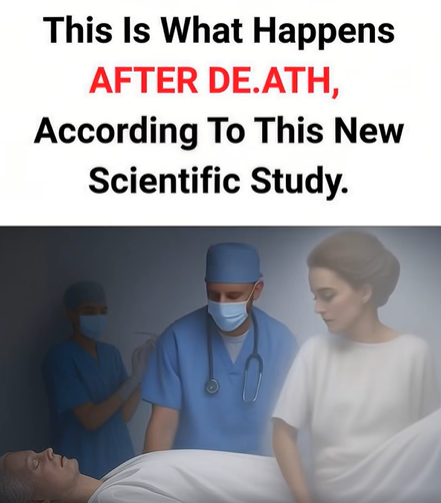
The images depict a powerful metaphor—a woman’s spirit calmly rising as medical professionals declare the body deceased. Her face is peaceful. The scene is quiet.
In clinical studies, EEG readings from patients who flatlined showed brief surges of gamma brainwaves—waves often associated with memory recall and intense awareness.
Could this explain the “life flashing before your eyes” phenomenon?
Reports of Awareness After Death
Some revived patients reported:
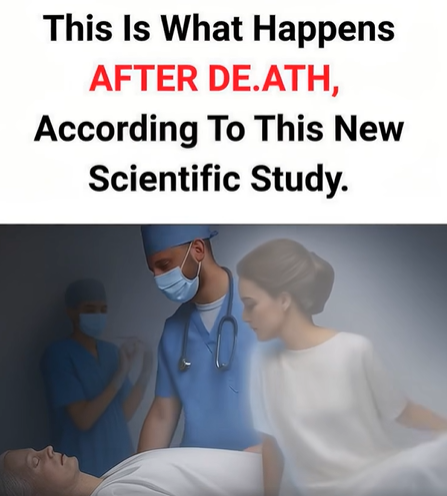
- Feeling detached from their bodies
- Watching doctors work from above
- Hearing sounds and voices while technically dead
This phenomenon has led researchers to hypothesize that the mind may remain active for a short time, potentially explaining sensations of floating, light, and peace.
Scientists Tread Carefully
While this doesn’t “prove” the afterlife, it raises profound questions. Dr. Sam Parnia, a leading researcher in resuscitation science, stated:
“The mind and consciousness may continue even after the brain has shut down.“
This opens conversations between neuroscience, spirituality, and human experience like never before.
What Does It Mean for Us?
For some, this brings comfort. For others, awe.
If even science acknowledges a mysterious window after death… could it mean something lies beyond?
In the End, a Beginning?
Whether you see it as energy, soul, or neural echoes, this study reminds us:
Death may not be an instant “end,”
but a transition.
One we’re only beginning to understand.